

Article: What is Scandinavian interior design, really?

What is Scandinavian interior design, really?
Scandinavian interior design has been reduced, over about fifteen years of image sharing, to a look: white walls, pale oak floor, one grey sofa, a plant. That is a copy of the surface. The thinking underneath it is more specific and a good deal more useful.
It starts with a problem, not a style
Northern Europe gets very little daylight for a large part of the year. In December, Copenhagen has around seven hours between sunrise and sunset, and much of that is overcast. Every decision in a Scandinavian room is downstream of that fact.
Pale walls and floors are not an aesthetic preference. They bounce what little light there is deeper into a room. Windows are left largely unobstructed for the same reason. Furniture sits low so it does not block sightlines to the glass.
Once you understand that the light is the problem being solved, the rest of the vocabulary makes sense.
The five things that actually define it
1. Function comes first
A chair is judged by whether it is comfortable to sit in for two hours. A design that looks striking and sits badly has failed, regardless of how it photographs. This is the part most often lost in translation.
2. Natural materials, left recognizable
Oak, ash, wool, leather, linen, stone. Crucially, they are finished so you can still tell what they are. Oak is oiled rather than lacquered so the grain stays visible and the wood keeps aging. Wool is left with its texture intact. The material is the decoration.
3. Restraint, not emptiness
A Scandinavian room is edited, not bare. The difference matters. Fewer objects, each of which earns its place, is the goal. A room stripped of everything personal reads as a showroom, and no one in Denmark actually lives that way.
4. Texture doing the work that color usually does
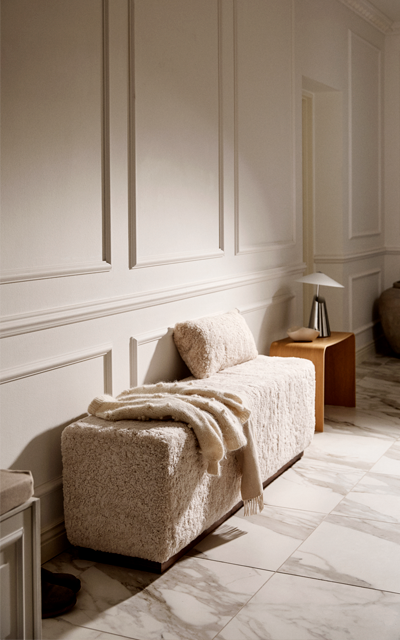
This is the one people miss. If your palette is largely neutral, texture becomes your only source of contrast. A sheepskin over the arm of a linen sofa, a wool throw against oiled oak, a smooth leather pouf on a rough rug: that is where the depth comes from. Take the texture away and a neutral room goes flat and cold immediately.
5. Built to last
The Danish furniture tradition assumes a piece stays in the family. That shapes construction: solid wood rather than veneer over board, joinery that can be repaired, upholstery that can be replaced. It is also why the prices are what they are.
Hygge, and what it is not
Hygge became an export product around 2016 and lost most of its meaning on the way out. It does not mean candles and blankets, although those help. It describes a quality of ease in a space and the company in it: warm enough, dim enough, informal enough that nobody is performing.
The practical translation for a room is this. Light it in layers rather than from a single overhead fixture. Give people somewhere soft to put their feet. Make the seating face inward toward each other rather than outward toward a screen.
How to do it without ending up in a showroom
Start with the floor and the walls. Get those pale and warm, not stark. A white with a little yellow or grey in it reads far better in low light than a pure brilliant white, which turns blue at dusk.
Then add one large soft thing. A rug is usually the fastest way to stop a pale room feeling like a corridor. A single large sheepskin rug or a cowhide does more for a room than three small accessories.
Layer the seating. A sheepskin over a chair back, a wool cushion in a different weave, a throw that actually gets used. Three textures in a neutral palette will read as considered; three colors will read as busy.
Buy fewer, better pieces. One lounge chair you keep for twenty years beats four you replace. This is the least fashionable advice in interiors and the most Scandinavian.
Leave something imperfect. Natural hides vary, oak darkens, leather creases. A room where everything is uniform and new has missed the point.
Where the tradition comes from
The Danish Modern movement of the mid twentieth century, Wegner and Juhl and Jacobsen among others, established the principles that still hold: honest materials, visible craft, comfort as a requirement rather than a bonus. Our own furniture is built in Denmark in that tradition, in solid oak and whole sheepskin hides rather than veneer and trimmed panels.
You do not need original mid century pieces to get this right. You need to make the same decisions they made.
The short version
Scandinavian interior design is a response to darkness. Pale surfaces to move the light, natural materials left legible, texture instead of color, fewer objects chosen more carefully, and everything built to survive being used. Get those right and the look follows on its own.